
This activity uses content from the Research Skills module of ORCIT (Online Resources for Conference Interpreter Training), which is licensed under a Creative Commons license.
Learning Outcome
By completing this activity, you will learn how to research effectively for an interpreting assignment and transform a professional research framework into a personal, reusable research checklist for future interpreting jobs.
Instructions
1. Explore a professional interpreting research framework (OER input)
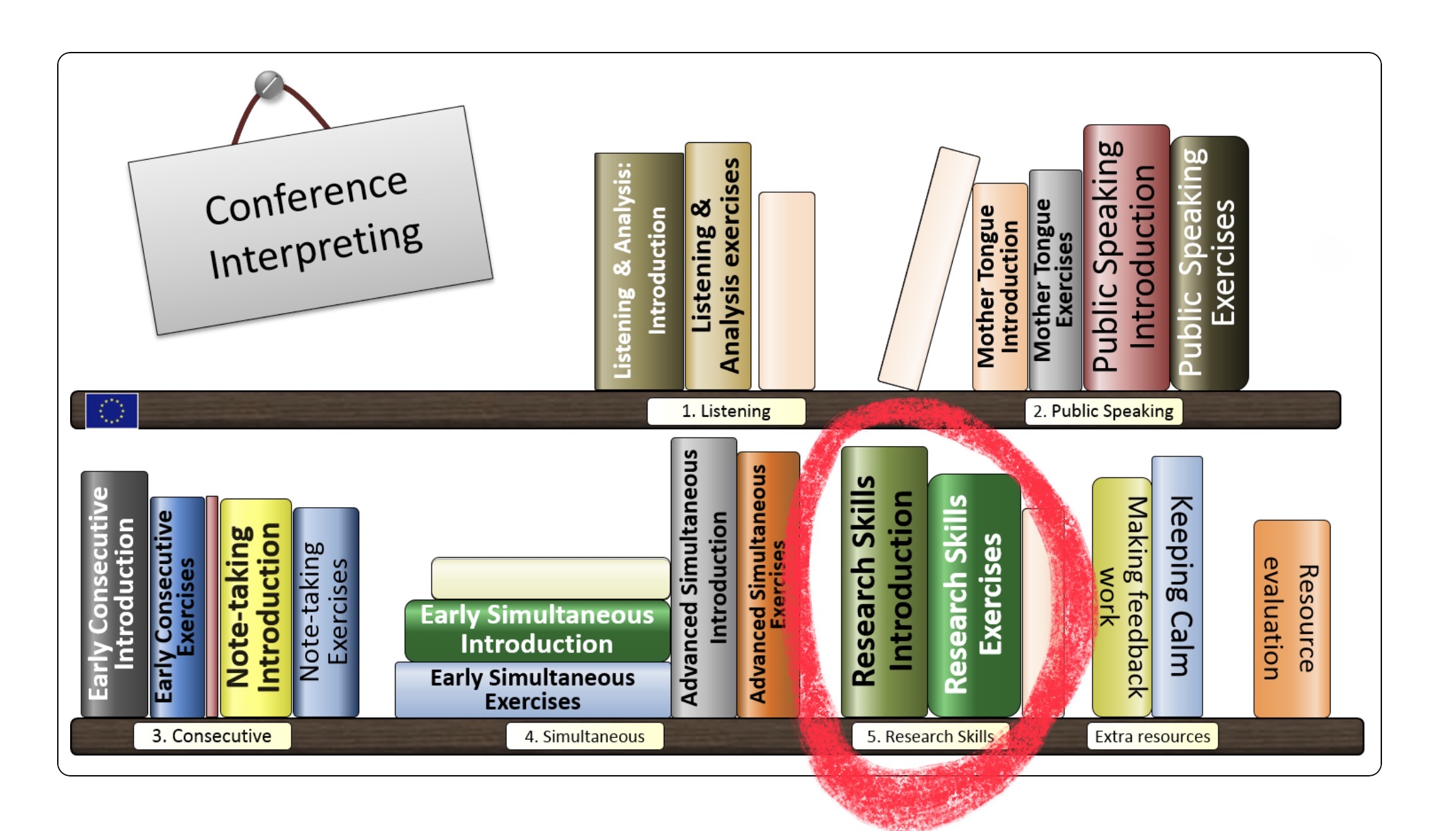
For this activity, you will use an open educational resource (OER) platform called ORCIT (Online Resources for Conference Interpreter Training).
- Visit ORCIT and open the Research Skills module.
- Study the instructional content (Research Skills Introduction), focusing on:
- What information interpreters need to research before an assignment
- How interpreting research can be structured efficiently
- What to prioritize when time is limited
The ORCIT materials are published under a CC BY-SA 4.0 DEED license – Attribution-ShareAlike 4.0 International.
2. Complete the ORCIT research skills exercise
Within the Research Skills module, go to Research Skills Exercises to complete the built-in mock event research exercise, which typically includes:
- Reviewing event-related documents
- Identifying key terminology
- Noting preparation priorities, risks, and unknowns
This step serves as a guided, authentic example of how professional interpreters prepare for assignments.
3. Create your personal interpreting research checklist
- Based on what you learned from ORCIT, create your own interpreting research checklist that you can reuse for future assignments.
- Your checklist may include areas such as:
- Event context and stakeholders
- Content and terminology preparation
- Speaker, materials, and format analysis
- Risks, unknowns, and last-minute checks
- This checklist should be:
- Personal
- Reusable
- Adaptable to different domains, time constraints, and working styles
- There is no single “correct” version.
4. Compare with a reference checklist and reflect
- After completing your checklist, review the reference professional checklist provided by the course.
- Treat this checklist as a reference only, not a standard to copy.
Interpreting preparation depends on the interpreter, the assignment, the domain, and time constraints.- Reflect briefly on:
- One item you revised or added after comparison
- One item you intentionally kept different
- One new insight you gained about interpreting preparation
What You Will Produce
1 personal interpreting research checklist
Notes for Evaluator
Related Topic: OER (Open Educational Resources)
ISTE Standards Addressed
- ISTE Student Standard 1: Empowered Learner
Learners independently engage with an open educational resource, apply professional frameworks, and create a personalized tool for future practice.
- ISTE Student Standard 3: Knowledge Constructor
Learners curate information from an OER, synthesize it with guided examples, and construct an original, reusable professional artifact.